03Services · 04
All servicesEPC Projects: Flowline & Pipeline Construction/
Pipelines, facilities & platforms. EPC projects on flowlines and pipelines, the facilities they feed, and the wellhead platforms at the end of them: built, maintained and kept in service.
The service
Flowlines and pipelines, built and kept in service.
Winsko takes flowline and pipeline work as an EPC contractor: the same team plans, procures, builds, tests and hooks up, and then keeps the line in service. Most of this work is on flowlines: the lines that carry well fluids and gas-lift gas between wellheads, manifolds and flow stations. Since 2013 that has meant new flowlines and gas-lift lines, sectional replacement of corroded lines, leak repairs on live lines, and hook-ups to wellheads and flow stations for operators in the Niger Delta.
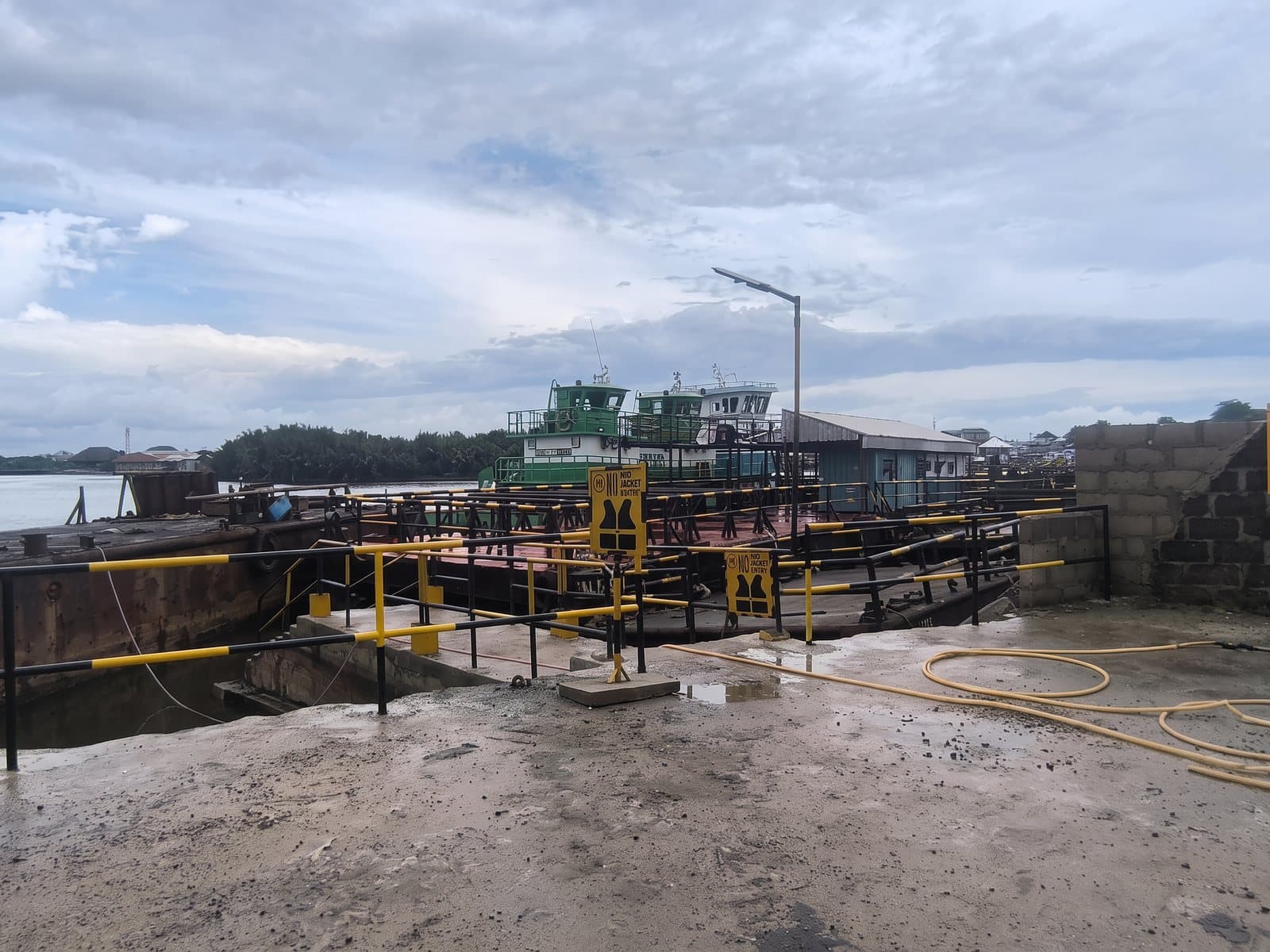
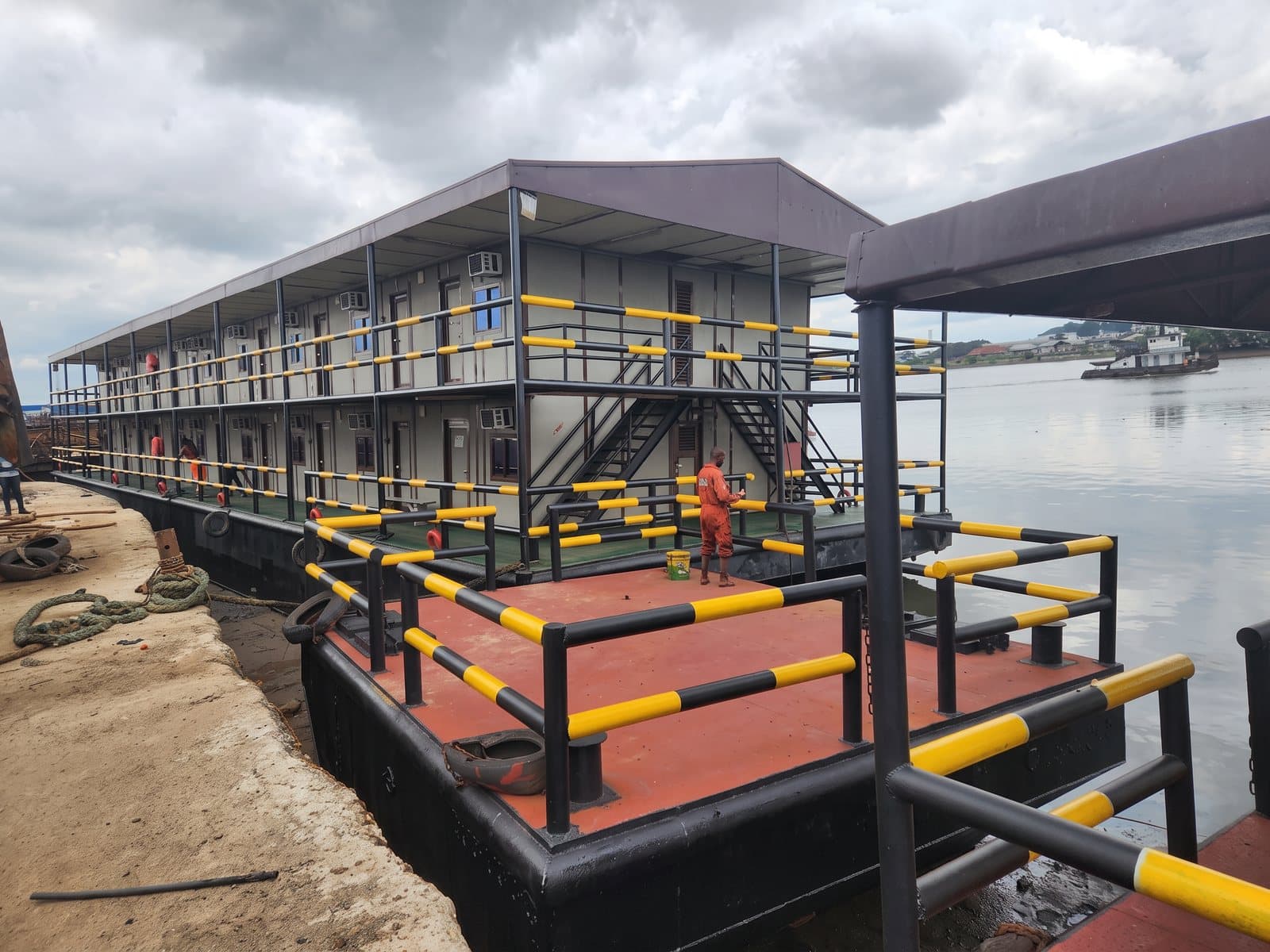
The sites are mostly swamp and creek locations in Rivers and Bayelsa, at fields such as Cawthorne Channel, Alakiri, Akaso and Krakama. Crews, pipe and plant go out from the company's own jetty at Trans-Woji, Port Harcourt, on its own barges, tug boats and swamp buggies, with a house boat for the crew, so a job does not wait on a hired marine spread.
Each job runs to an approved welding procedure, a coating specification and an inspection and test plan, and closes with a record of every weld, repair and pressure test.
Where it sits in the project lifecycle
- 01Engineering / Design
- 02Procurement & Logistics
- 03Fabrication
- 04Construction / Roads / Erection / Installation
- 05Testing / Pre-Commissioning
- 06Commissioning
- 07Operation, Maintenance & Handover
By the numbers
- 1.6 km
- Flowline replaced
- Cawthorne Channel 1 Well 16, with hook-up and a new wellhead platform (2024)
- 6.5 km
- Longest gas-lift line
- Akaso 011, built at Akaso in 2019
- 8
- Swamp buggies owned
- Wilco 3200 amphibious excavators for swamp right-of-way
- 27
- Welding machines
- Lincoln, Miller and Daewoo, 220 to 600 A, diesel and electric
Scope of work · 06 work packages
What the work covers.
- 01
Flowline construction
New flowlines and gas-lift lines, including runs of several kilometres.
- 02
Sectional replacement
Cutting out corroded or failed sections of existing flowlines, replacing them and returning the line to service.
- 03
Leak repair and clamping
Planned and emergency leak repairs on live flowlines, by clamp or by section.
- 04
Hook-up
Tie-ins to wellheads, manifolds and flow stations, with the isolation and permits agreed with the operator.
- 05
Maintenance and integrity
Planned and emergency maintenance on flowlines and pipelines, with integrity checks to decide what to clamp, what to replace and when.
- 06
Marine and swamp spread
Barges, tug boats, swamp buggies, cranes and house boats from the company's own fleet.
Method · 10 stages
From load-out to hook-up.
The stages of a flowline replacement or new line in swamp and on land, in the order the work is carried out, with the checks that close each one.
- 01
Survey and right-of-way
The route is set out from the approved drawing, existing lines and crossings are located, and the right-of-way is cleared. Where the ground will not carry ordinary plant, swamp buggies clear and open the corridor.
- Centreline and working width pegged
- Existing pipelines located and marked
- Access by land or water agreed before clearing
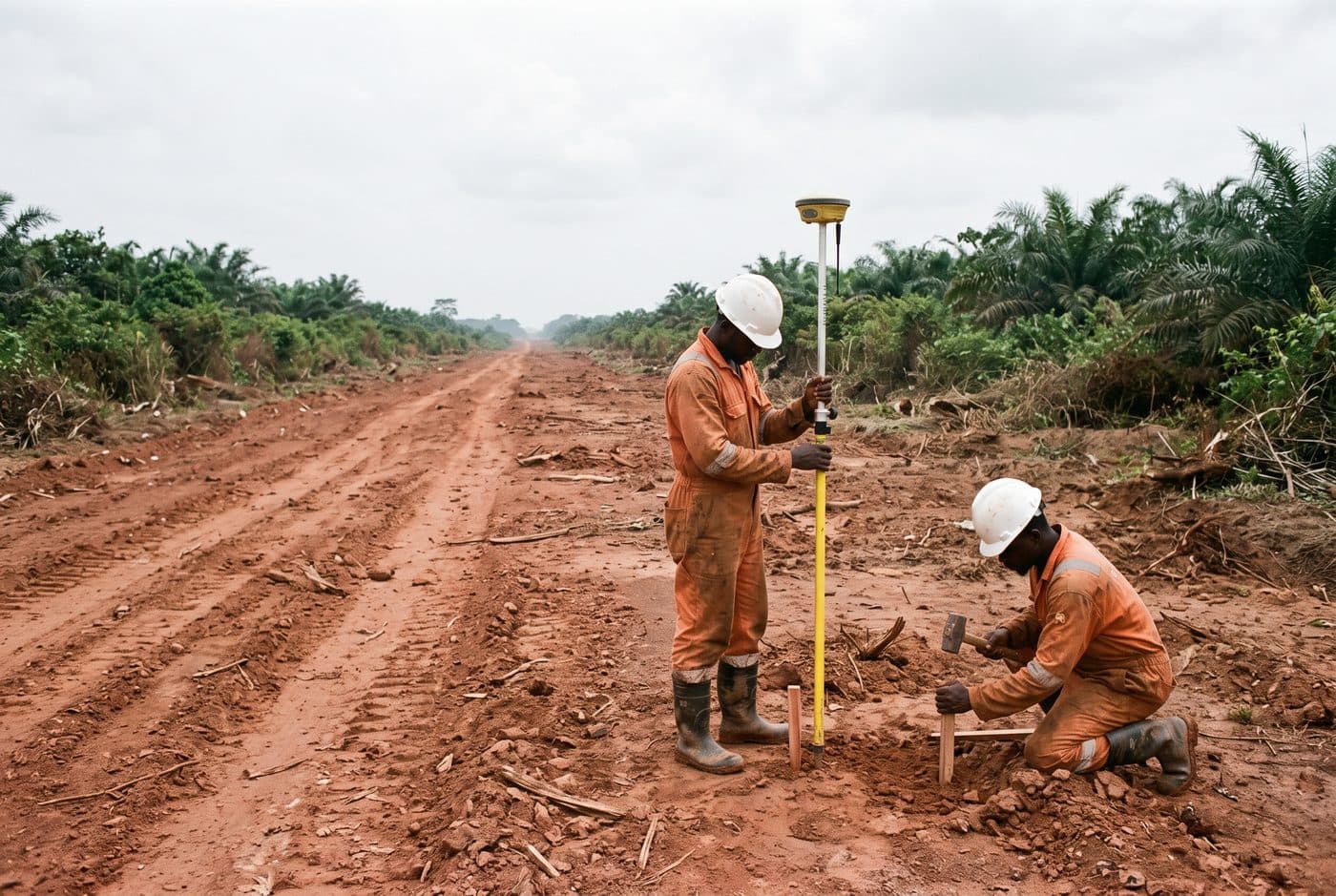
Setting out the right-of-wayIllustration - 02
Load-out and mobilisation
Pipe, fittings and plant are loaded at the company's jetty at Trans-Woji onto its own barges, then towed to site with the tug boats. A crane barge, swamp buggies and a house boat for the crew go out with the spread.
- Pipe and fittings checked against their certificates before load-out
- Lift plan for every crane lift onto the barge
- Marine crew, life jackets and transfer plan in place
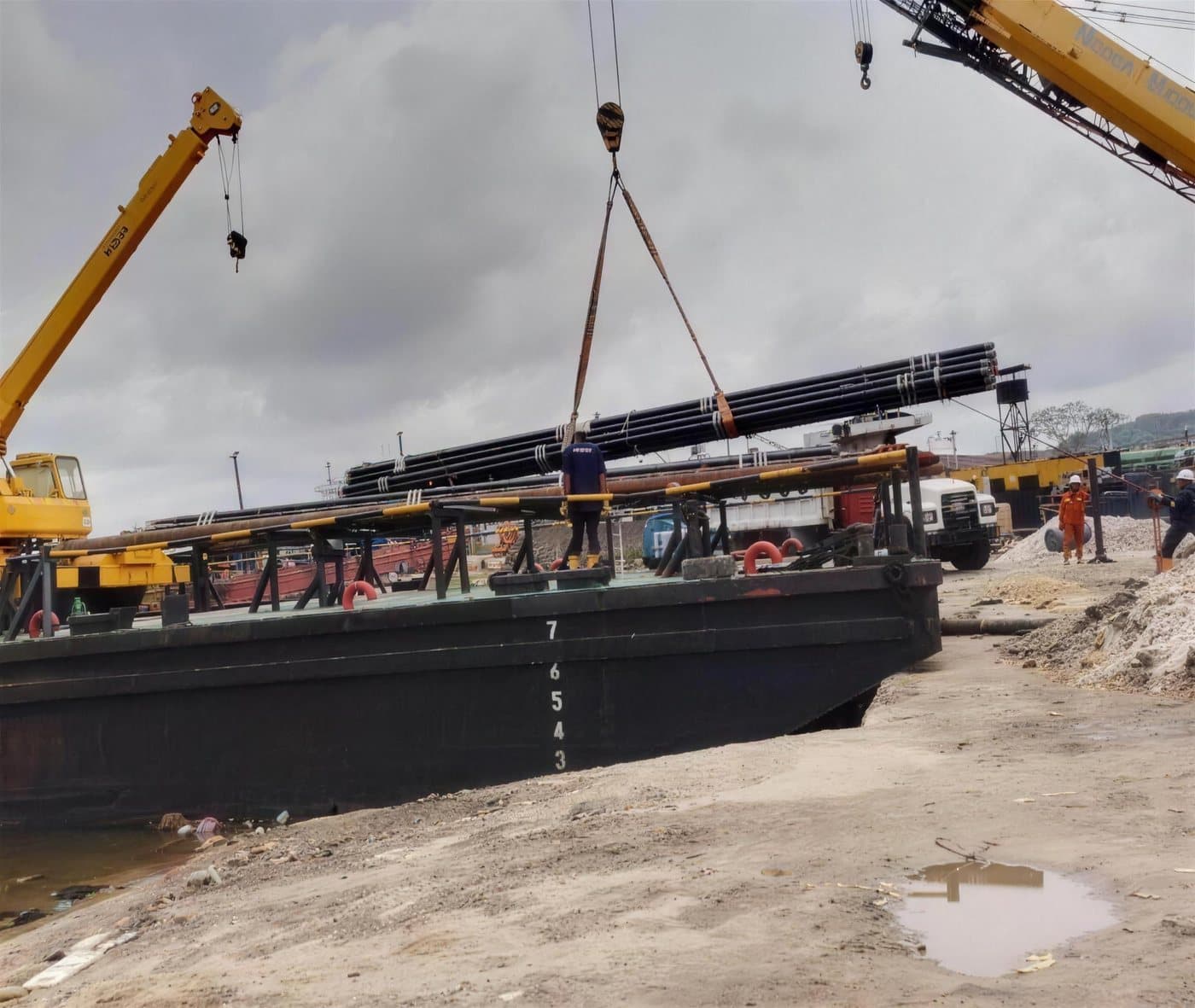
Load-out at the jetty, Cawthorne Channel 1 W16Photograph - 03
Excavation
On land, excavators open the trench to the depth of cover on the drawing. In swamp, swamp buggies dig and keep the ditch open, and water is pumped out before pipe goes in.
- Depth of cover and width checked against the drawing
- Trench walls battered or supported in soft ground
- Spoil kept clear of the working side
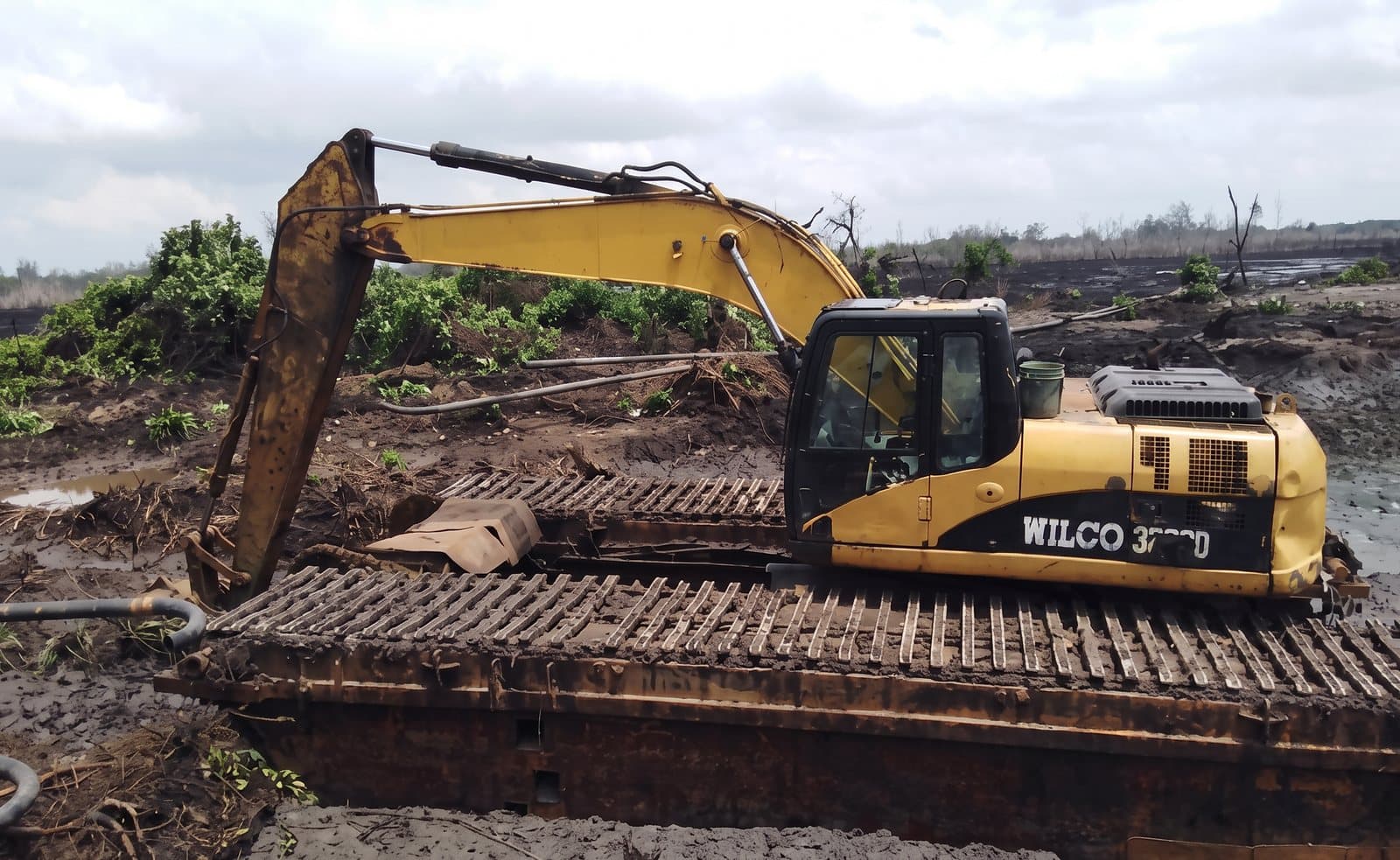
Swamp buggy on the right-of-way, Cawthorne Channel 1 W16Photograph - 04
Isolation and cut-out
On a sectional replacement the failed section is isolated and depressurised with the operator, the area is gas-tested, and the old pipe is cut out at the agreed points.
- Permit to work and isolation agreed with the operator
- Gas test before and during every cut
- Line ends prepared for the new section
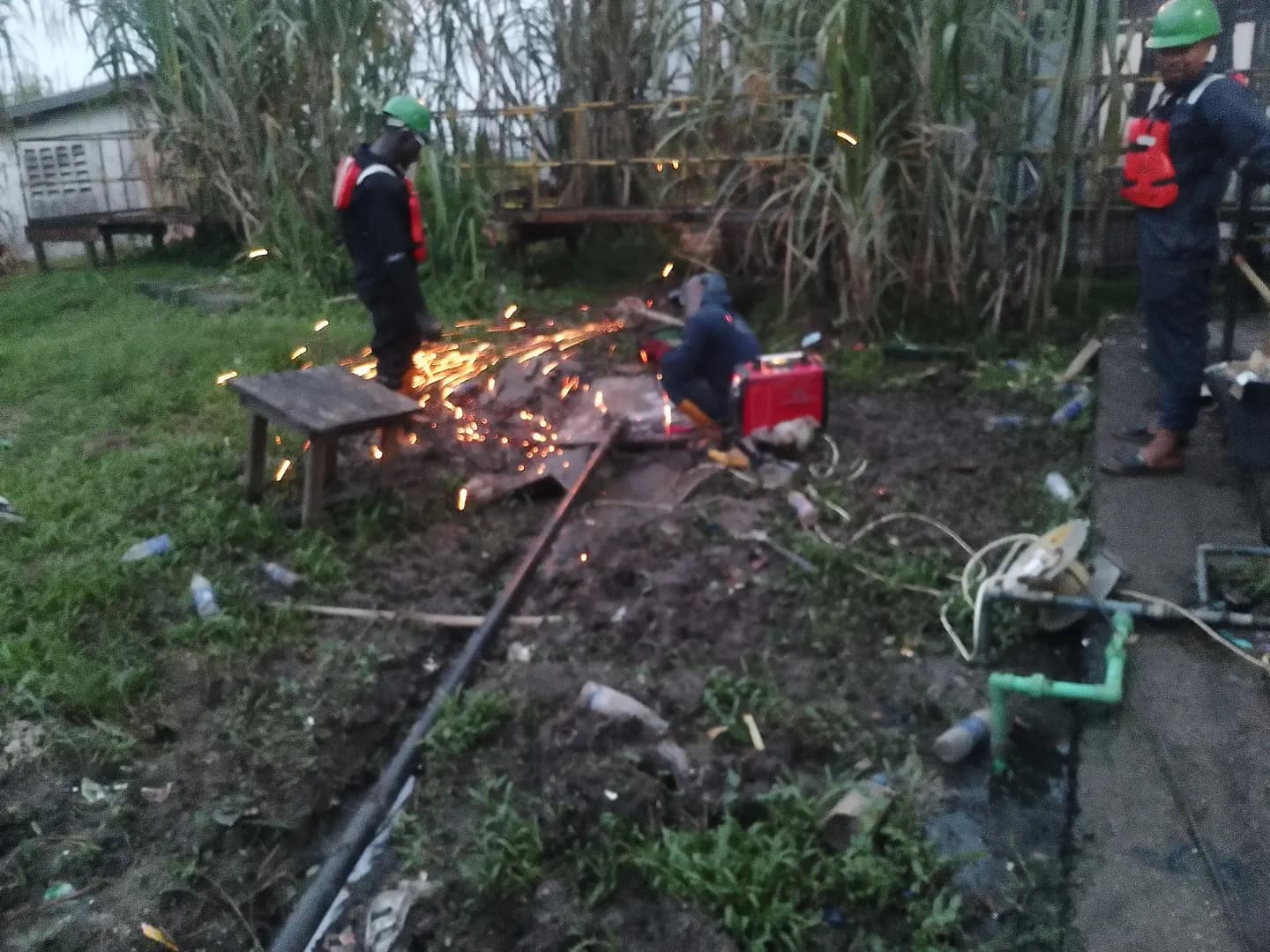
Cutting out a section on landPhotograph - 05
Welding
New pipe is lined up and welded to a qualified procedure, root pass first, then hot pass, fill and cap. Each weld is numbered on the weld map and logged against the welder who made it.
- Welding procedure and welders qualified before production
- Preheat, interpass temperature and electrodes controlled
- Every weld numbered and logged
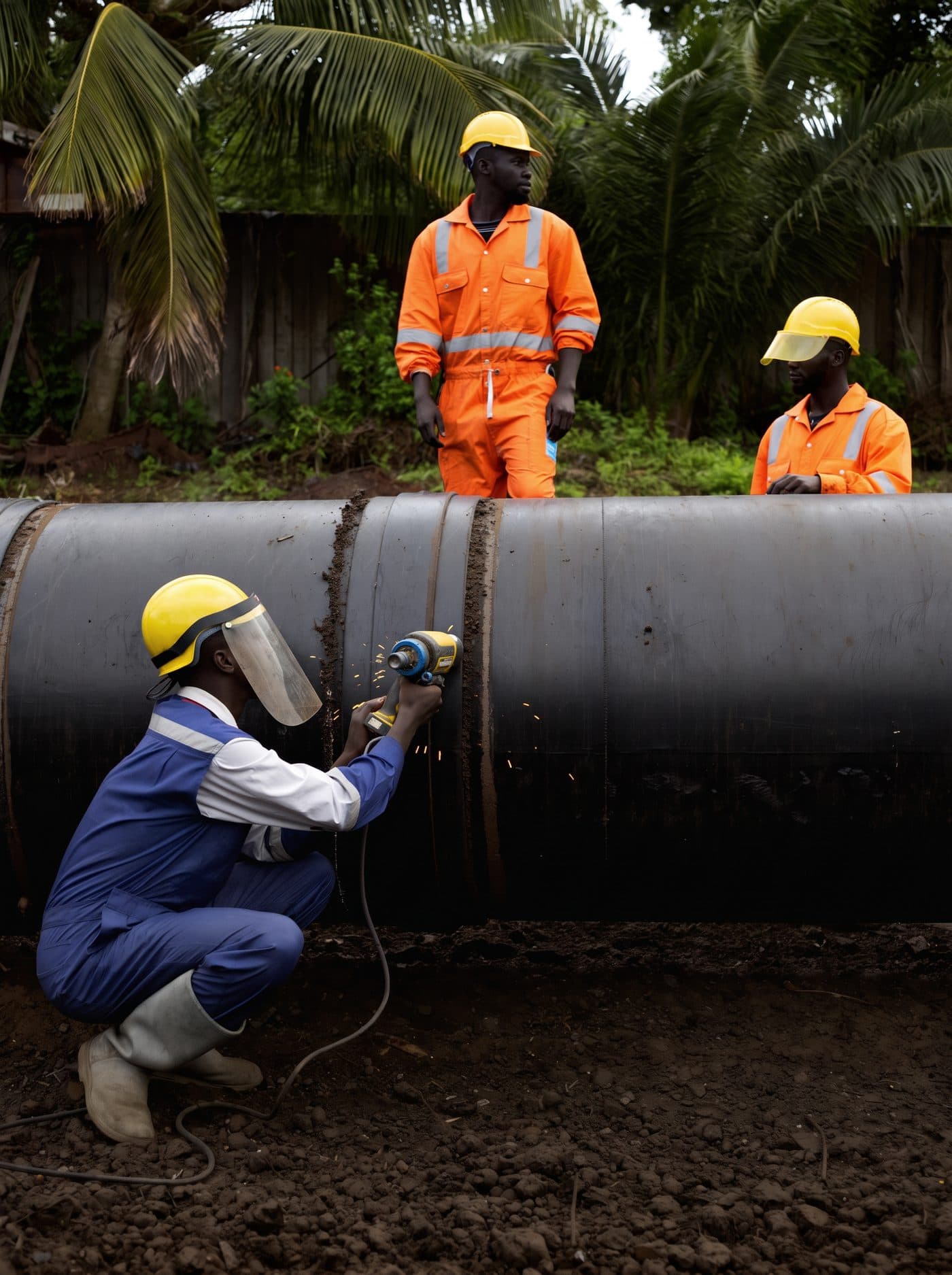
Girth weldIllustration - 06
Weld inspection
Welds are inspected visually and by the non-destructive testing the client specifies, radiography or ultrasonic testing. Rejected welds are repaired or cut out and inspected again.
- Method and acceptance criteria set in the inspection and test plan
- Every repair re-inspected
- Reports tied to weld numbers
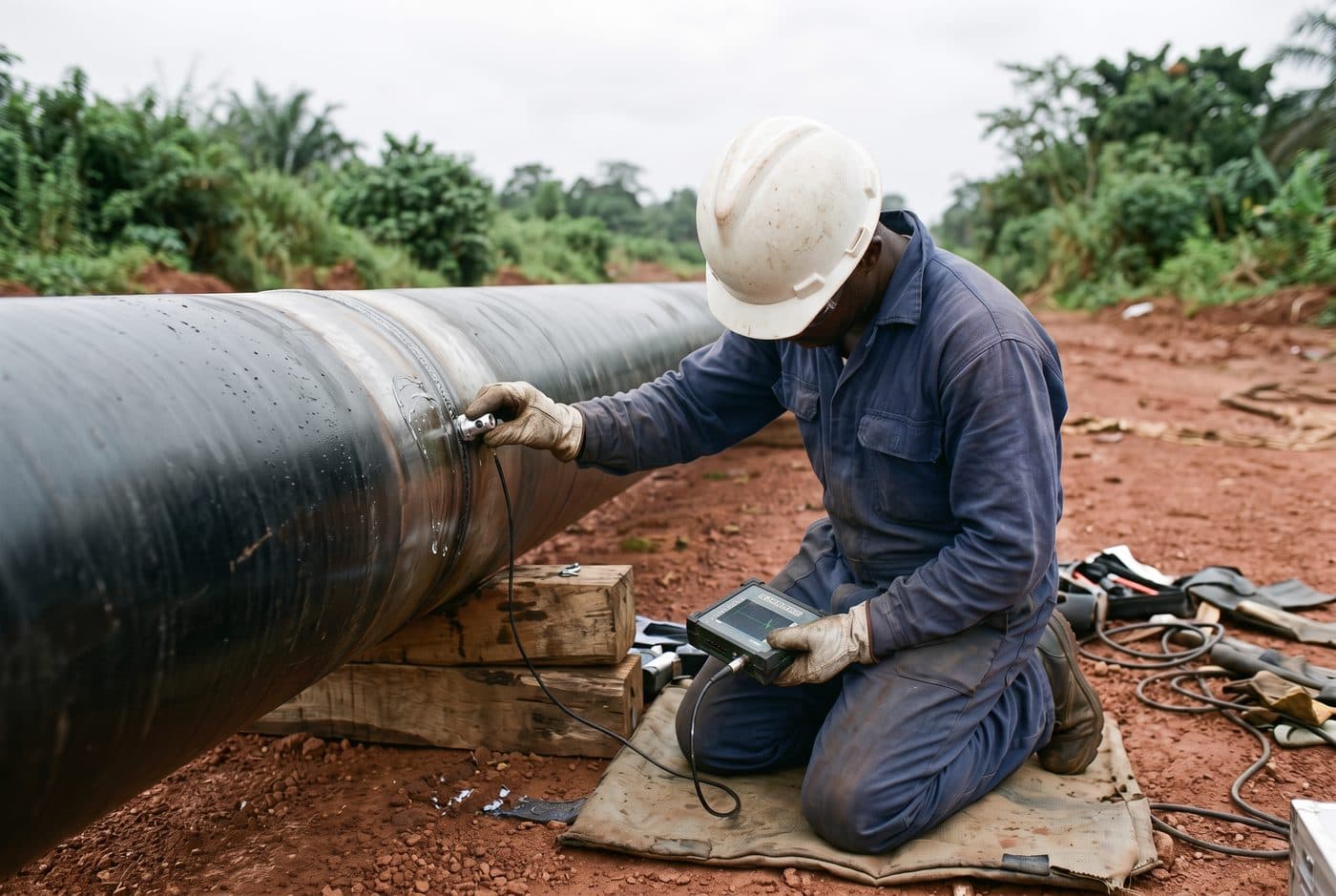
Ultrasonic weld inspectionIllustration - 07
Field joint coating
The bare steel at each weld is blast-cleaned and coated, with a heat-shrink sleeve or liquid coating, to close the gap in the factory coating. A holiday detector is run over it to find pinholes.
- Surface preparation and steel temperature checked first
- Holiday test over the full joint
- Damage repaired and tested again
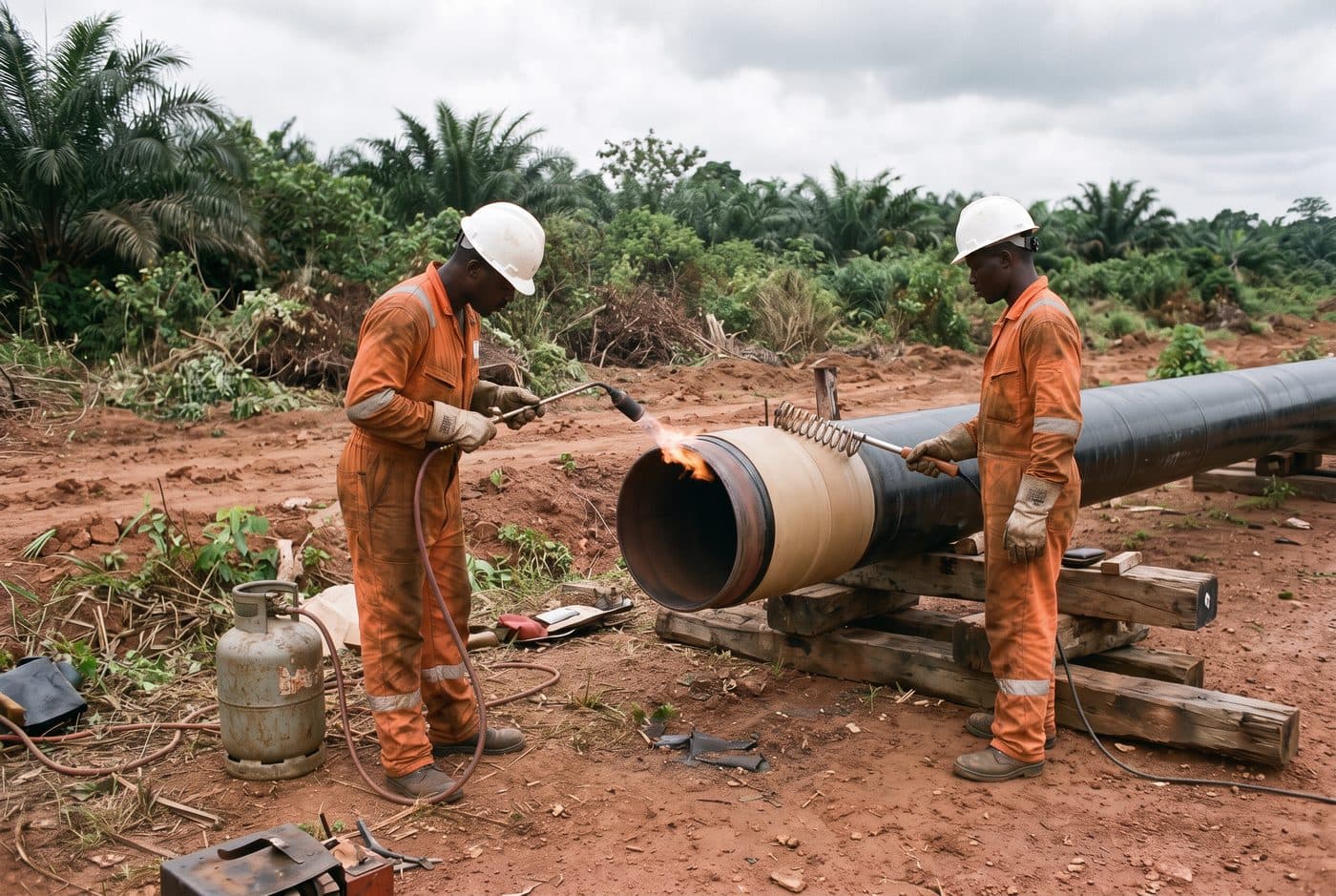
Field joint coatingIllustration - 08
Laying and backfill
The coated line is laid into the ditch from the bank, the barge or the swamp buggies, and supported so the pipe and coating are not overstressed. The ditch is backfilled and the right-of-way reinstated.
- Coating holiday-tested just before laying
- Pipe resting on an even bed
- Backfill placed and the ground reinstated
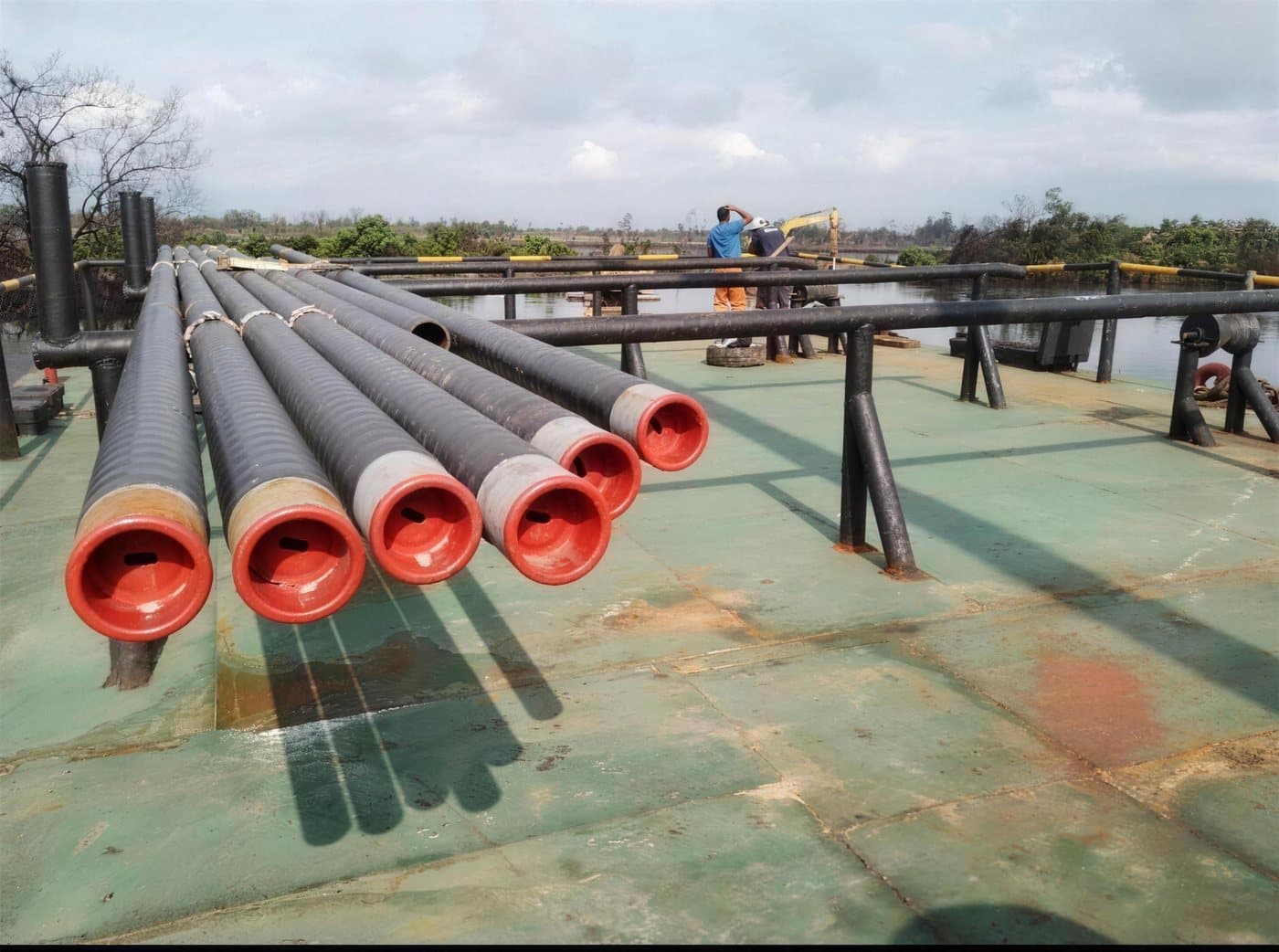
Coated line pipe on the barge, Cawthorne Channel 1 W16Photograph - 09
Flushing and hydrostatic test
The line is flushed with the flush pumps, filled with water and held above its design pressure for the period the design code sets, with pressure and temperature recorded throughout, then dewatered.
- Test pressure and hold time taken from the design code
- Calibrated gauges and chart recorder
- Test pack signed by the client's representative
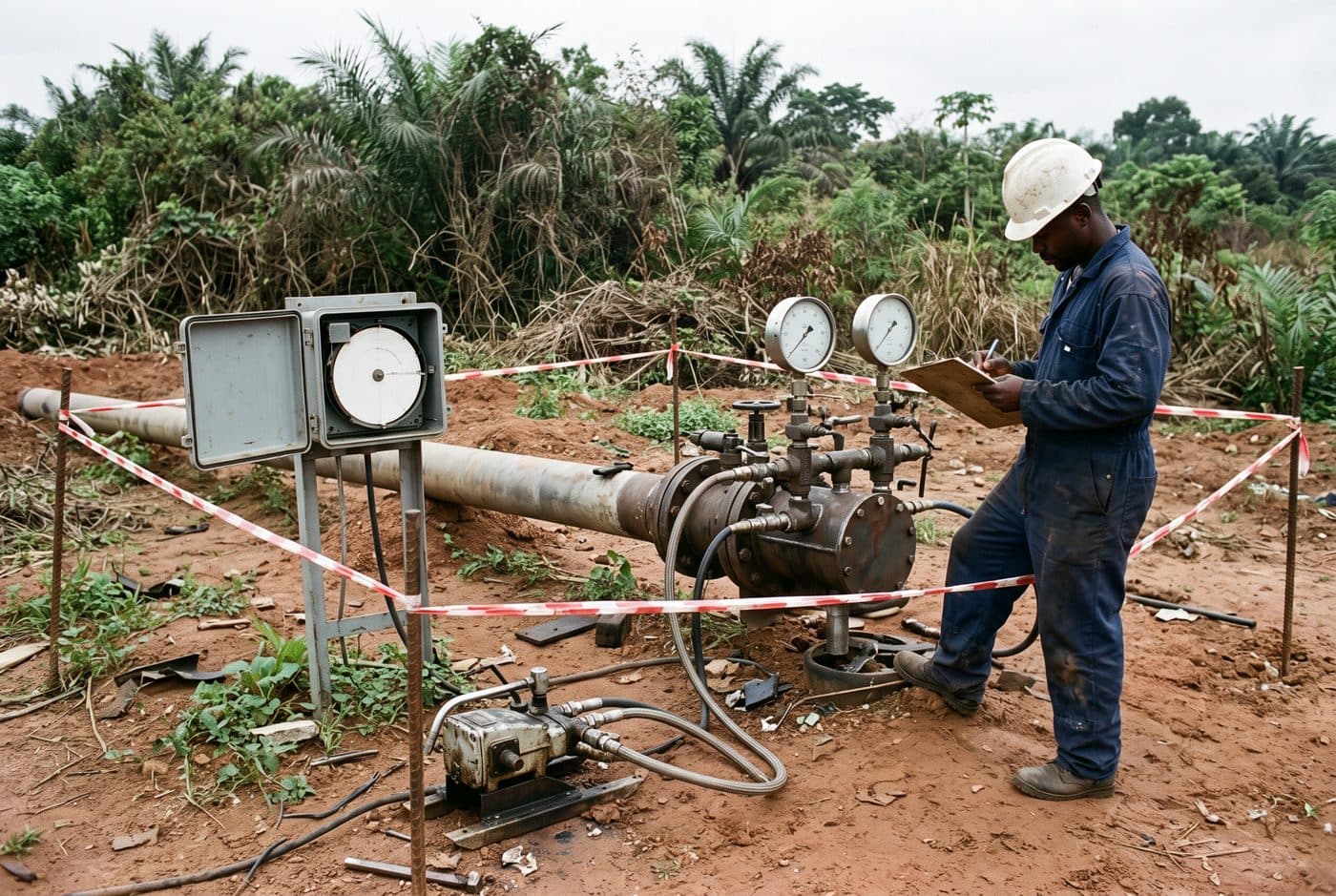
Hydrostatic testIllustration - 10
Hook-up
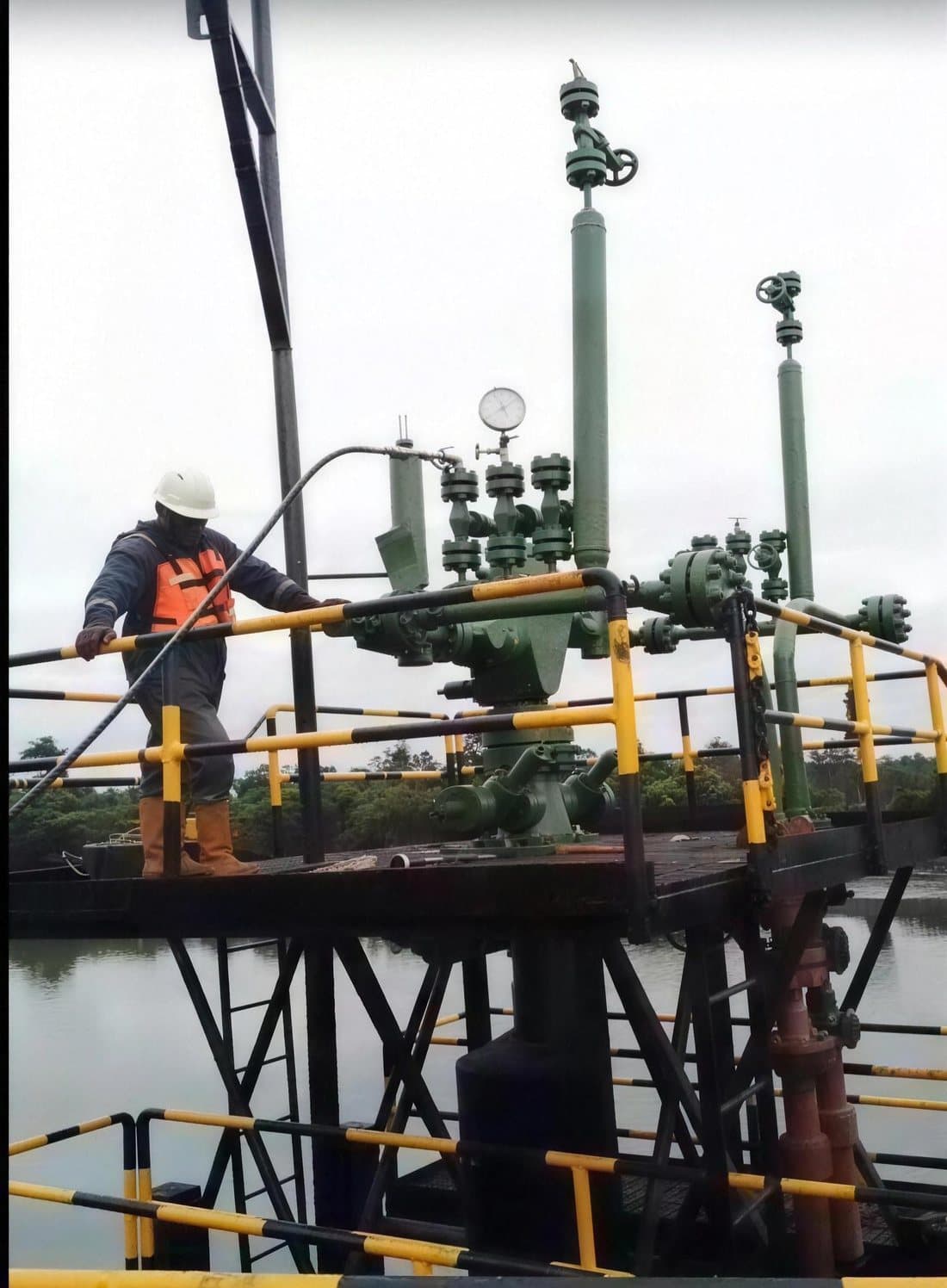
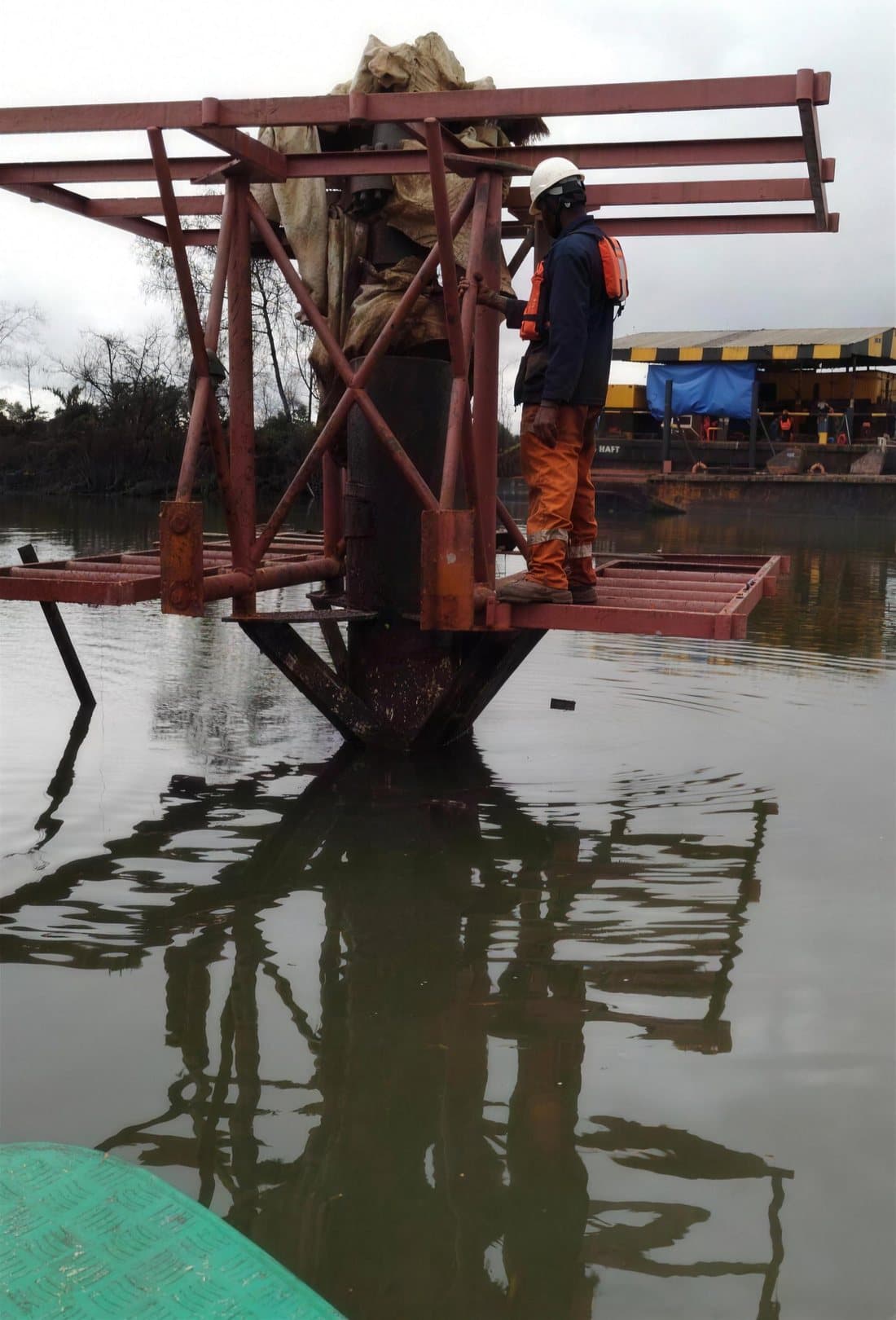
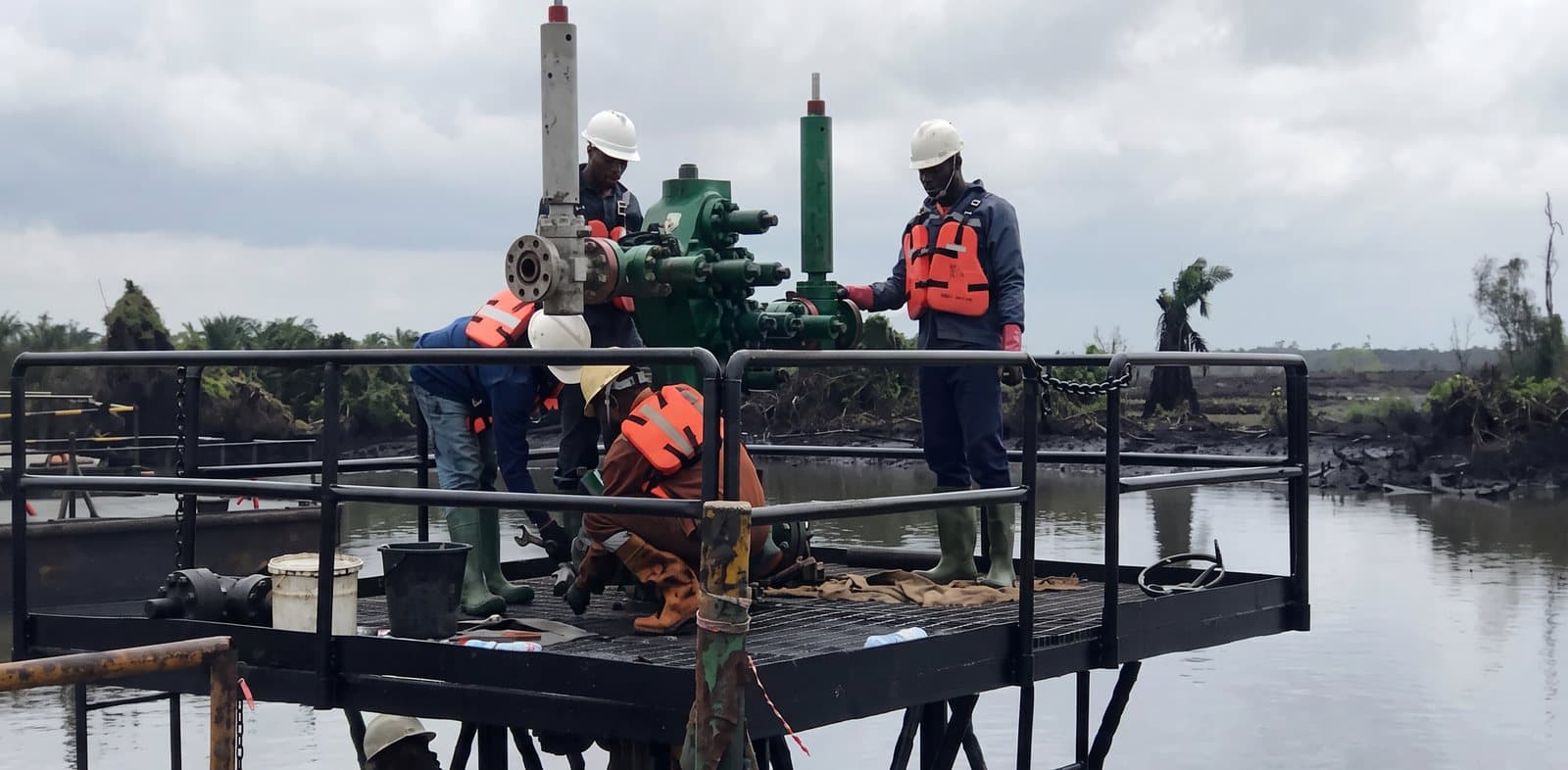
The tested line is connected to the wellhead, manifold or flow station at the agreed points. Where a wellhead platform is part of the scope it is installed first, then the line is hooked up and returned to the operator.
- Isolation and permit to work agreed with the operator
- Closing welds fully inspected
- Leak test on start-up and as-built records handed over
Wellhead hook-up, Cawthorne Channel 1 W16Photograph
Plant and equipment
Our own spread, from the jetty to the joint.
Flowline jobs in the swamp stand or fall on marine and swamp plant. Winsko owns the spread it uses, so the plan is not built around what can be hired that week.
- Swamp buggies
- 8 × Wilco 3200 C and D
- Lay barges
- 600 t and 500 t
- Ramp and dump barges
- 400 t to 1,200 t
- Track crane
- 80 t, crawler
- Welding machines
- 27 units, 220 to 600 A
- Flush pumps
- 4 units, 4" suction, 2" discharge
- Compressors
- Ingersoll-Rand, 600 and 450 CFM
- House boat
- 80-man accommodation
From the record
Cawthorne Channel 1, Well 16
Sectional replacement of a 1.6 km flowline at a swamp location on the Cawthorne Channel, with hook-up to the well and installation of a new wellhead platform. Pipe and plant went out from the Trans-Woji jetty by barge.
- Line
- 4-inch Schedule 40 flowline
- Length
- 1.6 km sectional replacement
- Scope
- Replacement, hook-up, wellhead platform installation
- Setting
- Swamp and creek, Cawthorne Channel, Rivers State
 PhotographPhotographPhotographPhotographPhotograph
 Photograph
Track record
Twelve years of flowlines in the Delta.
A selection from the list of jobs in the company profile.
- 20244" × 1.6 km flowline sectional replacement and hook-up, Well 16Cawthorne Channel 1
- 2022Sectional replacement, Alakiri Well 37TAlakiri
- 2019Four gas-lift lines, 4.3 to 6.5 kmAkaso
- 2019Flowline construction and wellhead platform works, PMMO-1Akaso
- 2018Gas-lift bulkline construction for Wells 5, 13 and 17 and the gas-lift manifoldCawthorne Channel
- 2018Akaso Well 13L: seven leaks repaired, by clamp and sectional replacementAkaso
- 2017Flowline construction, Wells 8S, 14L and 16SKrakama
- 2016Flowline construction, Wells 9T and 27L, with a 4" and 6" gas lineAlakiri
- 2015–16Oil flowline sectional replacement, Wells 3S and 29SAkaso
- 2014–16Leak repairs by clamping on live flowlines, well by wellAlakiri, Cawthorne Channel and Krakama
- 2014Oil flowline replacement, Well 4TCawthorne Channel
Inspection and testing
Every weld has a record.
Quality on a flowline is proven, not assumed. Each check below produces a record that goes into the job's test pack, and the pack is what the operator accepts before the line goes back into service.
Codes commonly specified for this work
- API 5LLine pipe
- API 1104Pipeline welding and inspection
- ASME B31.4Liquid pipelines
- ASME B31.8Gas pipelines
- ISO 21809External coatings
- ISO 15589-1Cathodic protection
Health, safety and environment
The hazards are known. So are the controls.
Flowline work puts people beside live hydrocarbon lines, open ditches and suspended loads, near flames and stored pressure, and most days on water. Each hazard has a control planned before the work starts.
- 01
Live lines
Permit to work, isolation and depressurisation agreed with the operator, and gas testing before and during every cut.
- 02
Swamp and water
Life jackets on the water and the barge, planned boat transfers, and a rescue plan for every location.
- 03
Lifting
Lift plans for crane and barge work, certified slings, one banksman in charge and nobody under a suspended load.
- 04
Hot work
Hot work permits, gas testing, a fire watch and extinguishers at the joint.
- 05
Pressure testing
A marked exclusion zone, pressure raised in stages and only the test crew inside the barrier.
- 06
Open excavations
Walls battered or supported in soft ground, spoil set back from the edge, and no entry without a permit.
FAQ · 05 questions
Questions, answered.
Short answers about epc projects: flowline & pipeline construction/maintenance at Winsko, from the company profile.
01What flowline and pipeline work does Winsko carry out?
EPC projects on flowlines and pipelines, built and kept in service: new flowlines and gas-lift lines, sectional replacement of corroded lines, leak repairs on live lines, hook-ups to wellheads and flow stations, and planned and emergency maintenance, in swamp, creek and land locations in the Niger Delta.
02Can Winsko build flowlines in swamp locations?
Yes. Most of its flowline work is at swamp and creek sites in Rivers and Bayelsa. Swamp buggies clear the right-of-way and dig the ditch, and pipe, plant and crew are carried on Winsko's own barges and tug boats, with a house boat for accommodation.
03What is a flowline sectional replacement?
The corroded or failed section of an existing flowline is isolated with the operator, cut out, and replaced with new welded, inspected and coated pipe. The line is then pressure tested, hooked up and returned to service. In 2024 Winsko replaced 1.6 km of 4-inch flowline at Cawthorne Channel 1 Well 16, with hook-up and a new wellhead platform.
04Does Winsko repair pipeline leaks by clamping?
Yes. Leaks are clamped where a clamp will hold, and the pipe is cut out and replaced by section where it has thinned too far. On Akaso Well 13L in 2018, seven leaks on one line were repaired by clamp and sectional replacement.
05How is the quality of a new flowline checked?
Each job runs to an approved welding procedure, a coating specification and an inspection and test plan. Welds are numbered and inspected, field joints are coated and holiday tested, and the line is hydrostatically tested before hook-up, with a record of every weld, repair and test handed over.
07Start a project
Have a project
to build?
Tell us the scope, the site and the schedule. Flowlines and pipelines, facility maintenance, wellhead platforms, civil or mechanical works, procurement or equipment on lease: our team in Port Harcourt will prepare a quote.
We can do it for you. Try us.
Start with a service
- 01Marine & Land Logistics
- 02Land/Swamp Equipment Leasing
- 03Procurement Services
- 04EPC Projects: Flowline & Pipeline Construction/Maintenance
- 05Oil & Gas Facility Maintenance
- 06Wellhead Platform Fabrication & Maintenance
- 07Road Construction
- 08Civil Engineering Construction
- 09Mechanical Engineering Construction/Fabrication
Each one opens the quote form with that service already chosen.
01Call
02Call
03Email
04Email
Operational base / jettyElshcon Close, Trans-Woji (Slaughter), Port Harcourt, Rivers State
See it on the map